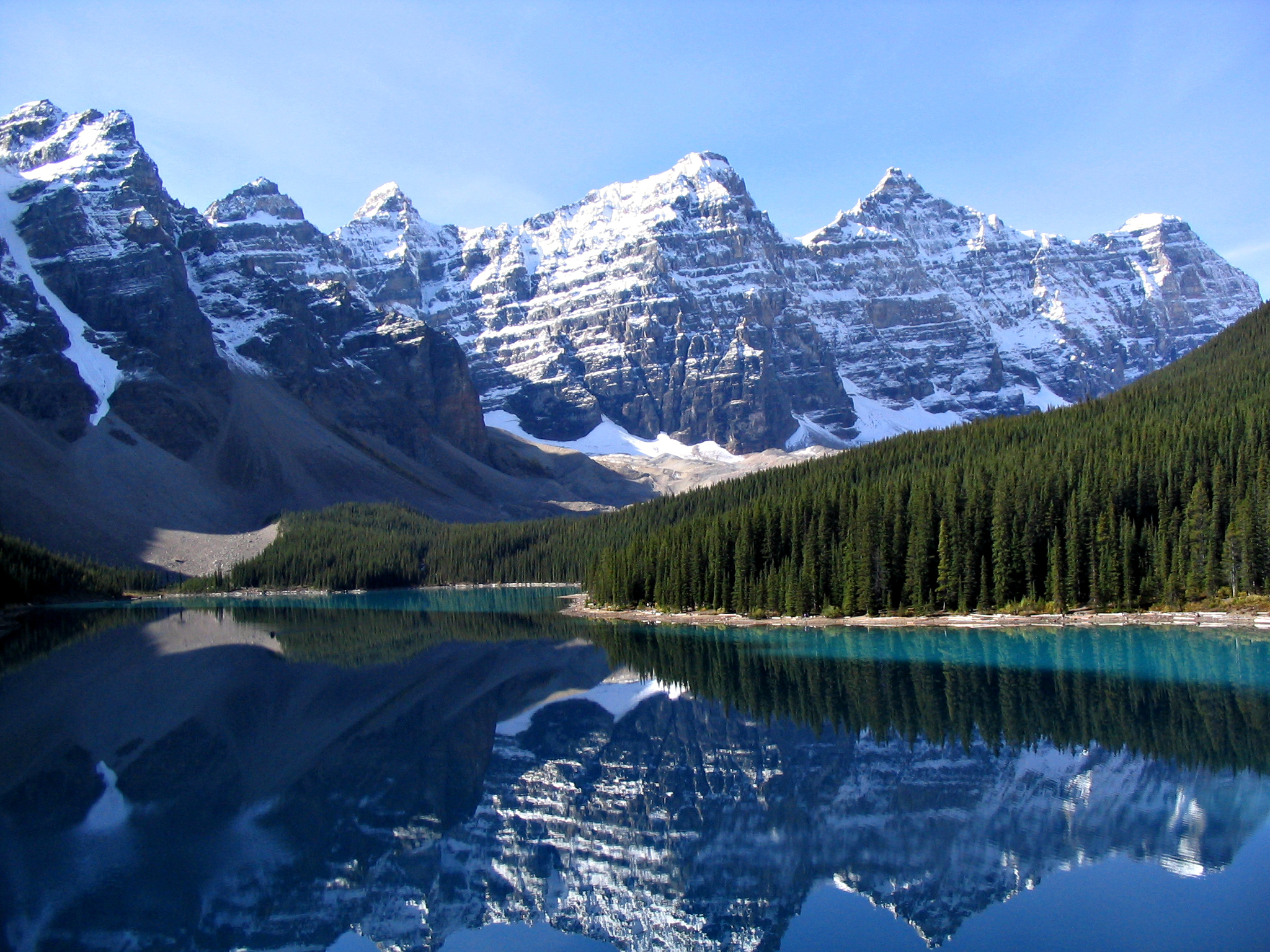
A wide outdoor scene gives the eye too many places to go. Composition is the process of deciding what the photograph is about and arranging the frame so the viewer reaches it. The techniques below are guidelines for that decision, not formulas.
Decide on a subject
Before framing, name the subject: a single peak, a curve in a river, the line where forest meets shore. A landscape without a clear subject tends to read as a record of a place rather than a photograph of something. Everything else in the frame should support that subject.
The rule of thirds
Dividing the frame into thirds horizontally and vertically gives four intersection points. Placing the subject, or a strong element such as the horizon, along these lines rather than dead-center often produces a more balanced image. Most cameras can display this grid in the viewfinder.
- Place the horizon on the upper third to emphasize foreground, or the lower third to emphasize sky.
- Set a lone subject on an intersection rather than the exact middle.
- Break the rule deliberately for symmetry, such as a still lake reflecting a peak.
Leading lines
Lines guide the eye through the frame. A shoreline, a trail, a fallen log, or a river can lead from the foreground toward the subject. Diagonal lines tend to feel more dynamic than horizontal ones. In mountain terrain, ridgelines and the edges of lakes are reliable natural leads.
Foreground, middle ground, background
Depth comes from layering. A near object — rocks, grasses, or a patch of wildflowers — anchors the foreground and gives scale to distant mountains. A wide-angle lens combined with a small aperture keeps all three layers acceptably sharp.
The glacial lakes of the Canadian Rockies, such as Moraine Lake and Lake Louise, are common subjects where a rocky shoreline foreground, the lake as a middle ground, and the surrounding peaks as a background combine naturally into three layers.
Balance and negative space
Empty areas are part of the composition. A calm sky or smooth water surface can give the subject room and a place for the eye to rest. Balance does not require symmetry; a small, sharp subject can hold its weight against a large quiet area.
Quick framing checklist
| Question | If unsure |
|---|---|
| What is the subject? | Recompose until one element dominates |
| Where is the horizon? | Move it off the center line |
| Is there a foreground? | Step closer to a near element |
| Any distractions at the edges? | Reframe or change position |
Continue reading
Composition assumes you can already control exposure — see Camera Settings for Nature Photography. The quality of light shapes every scene; read Working with Natural Light Across Canadian Seasons next.